



EHR Integration Guide


Across the healthcare ecosystem, from AI startups building clinical tools to payers modernizing prior authorization to health systems connecting disparate platforms, one challenge keeps surfacing at every level: getting data to flow reliably between systems.
EHR integration is at the center of that challenge. It's what determines whether a healthcare IT product can actually be sold into health systems, whether a payer can automate claims and eligibility in real time, and whether a clinician has the complete patient picture they need at the point of care.
More than 50% of integration projects fail or are never properly utilized. And satisfaction with EHR implementations has dropped every year since 2022, with just 38% of organizations saying their integration truly hit the mark (KLAS, 2025).
This guide covers what EHR integration actually involves, the benefits, the challenges, the real cost of failure, and how to build integrations that work and keep working.
Advantages of EHR integration
Healthcare IT Companies (Product Vendors)
- Skyrockets adoption and daily usage: Clinicians stay within your solution without switching apps, leading to consistent daily engagement, stronger user retention, and higher overall adoption rates.
- Removes the biggest sales obstacle: Being integration-ready opens doors to Epic-dominant enterprises, shortens sales cycles significantly, and helps close larger, higher-value deals much faster.
- Powers scalable recurring revenue: True clinical utility creates deeper customer entrenchment, unlocks module expansions, increases net revenue retention (NRR), and delivers more predictable, high-margin growth.
- Accelerates market expansion: A single FHIR-compliant layer connects you to Epic, Oracle Health, athenahealth, and others, allowing efficient targeting of hospitals, mid-market systems, and ambulatory practices simultaneously.
- Creates a durable competitive moat: Certified integrations raise barriers to entry for competitors, increase customer switching costs, strengthen pricing power, and enhance long-term defensibility.
In short: Seamless integration fuels faster sales, stickier customers, larger contracts, and higher company valuation.
Payers
- Receives clean, standardized clinical data from EHRs: Direct access reduces claim denials, cuts rework, and accelerates payment cycles.
- Automates prior authorizations via FHIR APIs: CMS mandate effective January 2026 makes FHIR-based automation mandatory; integration-ready payers gain compliance advantage and faster approvals.
- Enables real-time eligibility verification: Instant data exchange with provider networks minimizes delays, reduces bad debt, and improves member experience.
- Enhances risk stratification and population health: Longitudinal, cross-setting patient data delivers more accurate risk scores, better care management, and stronger value-based contracts.
- Strengthens auditing and fraud detection: Structured, auditable data flows improve accuracy, reduce false positives, and lower compliance risks.
In short: EHR integration turns regulatory mandates into competitive edges, faster revenue, lower costs, better risk management, and stronger provider relationships.
Providers
- Cuts physician burnout: Only 28% of physicians find cross-EHR data exchange easy, fueling ongoing stress (Athenahealth 2025 Physician Sentiment Survey). True integration eases this daily burden.
- Speeds care coordination: FHIR Integration-adopting providers report clear workflow and outcome gains (HIMSS 2024–2025 interoperability data). Bi-directional flow eliminates delays.
- Unlocks AI product adoption: With AI tools surging (86% of health systems using AI, Medscape/HIMSS 2024–2025), providers demand deep EHR integration to feed real patient data into predictive, ambient, or decision-support AI: otherwise these products stay unused.
- Activates patient engagement: 99%+ of U.S. hospitals offer electronic record access (ONC 2025), but only integrated solutions turn passive portals into meaningful, real-time collaboration.
Challenges in EHR Integration
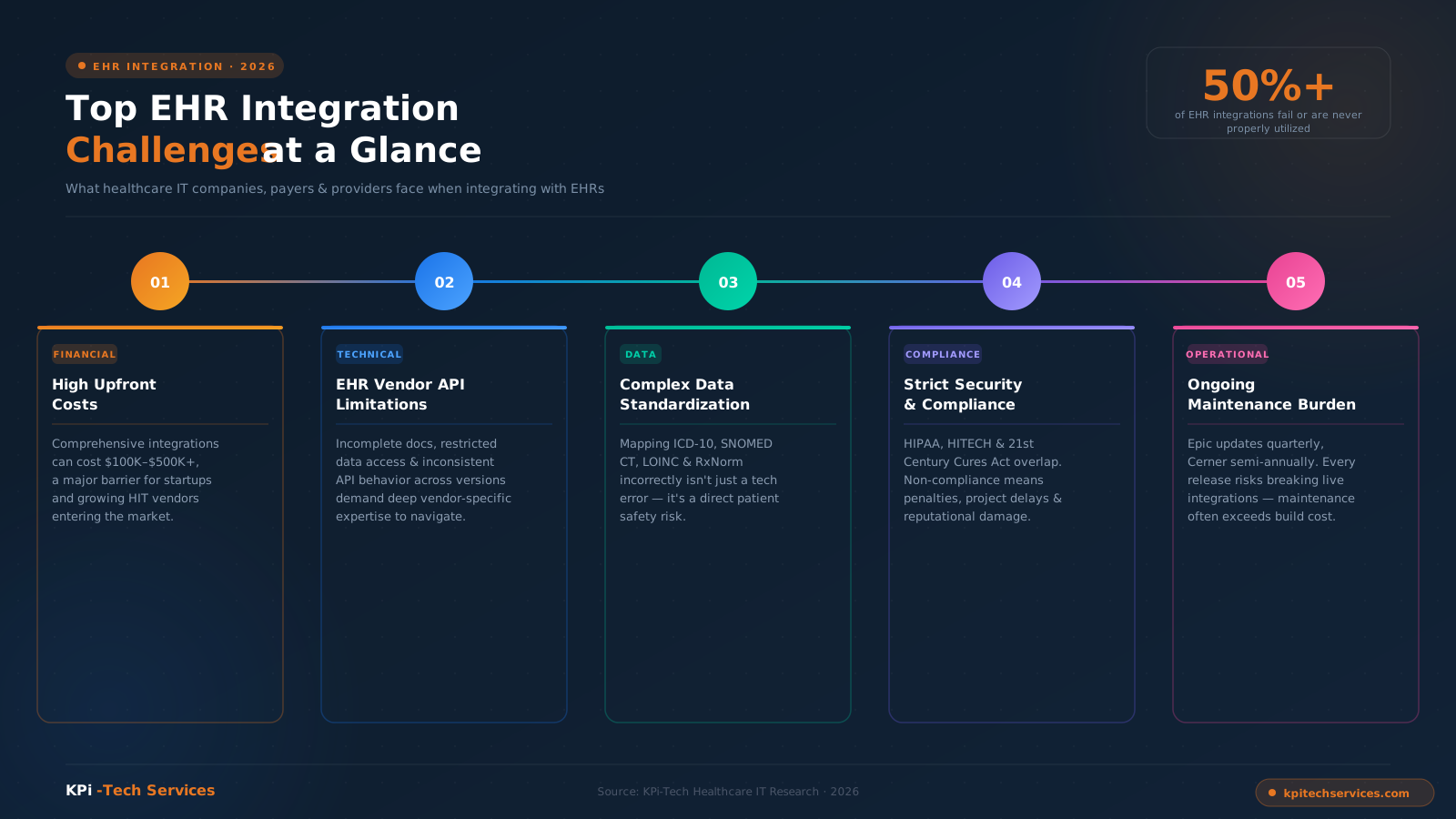
Healthcare data integration is a complex process due to several factors.
-
High Upfront Costs
Comprehensive EHR integration can cost anywhere from $100,000 to $500,000+, making it a serious barrier, especially for healthcare AI startups and digital health companies. Phased implementation and cloud-based FHIR tools can cut development costs by 40–60%.
-
EHR Vendor API Limitations
Many EHR systems have incomplete documentation, restricted data access, and inconsistent API behavior across versions. Legacy EHRs often lack modern API support entirely, requiring complex, time-consuming workarounds that demand deep vendor-specific knowledge.
-
Complex Data Standardization & Mapping
ICD-10, SNOMED CT, LOINC, RxNorm:different EHRs use different terminologies and data structures. Incorrect mapping isn't just a technical problem; it's a clinical one. Wrong data in the wrong field can directly impact patient safety.
-
Strict Compliance & Security Requirements
HIPAA, HITECH, and the 21st Century Cures Act create overlapping obligations: encryption, audit logging, access controls, information blocking prevention. Non-compliance means penalties, delays, and reputational damage.
-
Ongoing Maintenance Burden
Epic releases quarterly updates. Cerner semi-annually. Every release can break existing integrations. Add evolving USCDI standards and 24/7 monitoring needs, and ongoing maintenance often ends up costing more than the initial build.
To navigate these complexities and foster growth, developers of digital health solutions require a well-thought-out data integration strategy that enables seamless health data exchange with various stakeholders such as hospitals, payers, and public health agencies. While efficient integration can accelerate time to market, it often necessitates specialized expertise beyond the core competencies of development teams.
RELATED CASE STUDY: Solving the Challenge of Multi-EHR Data Integration
What Are the Consequences of EHR Integration Failure?
EHR integration failure triggers patient harm, burnout, financial strain, regulatory penalties, stalled innovation, and lost opportunity. In 2026's AI-heavy, mandate-driven landscape (including HTI-4 enforcement), robust integration is essential for survival:vendors/startups prioritizing it (middleware, direct certification, hybrid) gain a defensible edge.
- Financial & Operational Impact: Massive overruns (50–70% projects fail/require rework), revenue losses (denied claims, rework, bad debt, outages), high remediation costs (fixes, training, audits), hospital operating losses, lower receivables, and credit risks.
- Vendor & Startup Impact: Stalled sales cycles, lost deals (especially Epic-heavy), damaged reputation, wasted resources, inability to scale, competitive disadvantage as rivals with certified integrations gain market share faster.
- Regulatory & Compliance Risks: Non-compliance with HTI-4 (FHIR e-prescribing, real-time prescription benefit, automated prior auth mandates effective 2025–2026) and CMS FHIR requirements → penalties, certification loss, program exclusion.
- Systemic & Broader Effects: Hindered care coordination, increased duplication/equity gaps, stalled innovation (focus diverted to fixes instead of new features or AI advancements), rising malpractice exposure.
Key considerations for successful EHR Integration
Getting EHR integration right isn't just about writing good code:it's about making the right decisions before development even begins. These five considerations separate integrations that scale from ones that stall.
-
Choose the Right Integration Approach
Not every integration needs the same architecture. Point-to-point works for simple, limited connections. Interface engines like Mirth Connect or Rhapsody handle complex HL7 message routing at scale. Cloud-based iPaaS platforms offer flexibility and lower maintenance overhead. Picking the wrong approach early creates expensive rework later.
-
Standardize on FHIR From Day One
ONC's HTI-1 rule already mandates USCDIv3 FHIR API support. CMS's Prior Authorization Rule follows in January 2026. Building on FHIR R4 now with R6 on the horizon means your integration stays compliant without a costly rebuild every time regulations move.
-
Know Your EHR Vendor's Ecosystem
Epic, Oracle Health, athenahealth, and Meditech each have unique API behaviors, documentation gaps, and certification requirements. What works in one environment won't necessarily work in another. Deep vendor-specific knowledge isn't optional:it's what separates on-time deliveries from troubled projects.
-
Build Security In, Not On
Security added as an afterthought creates gaps. Every integration should be designed with end-to-end encryption, OAuth 2.0/SMART on FHIR authorization, role-based access controls, and full audit logging from the very first line of code:not patched in before go-live.
-
Plan for Maintenance Before You Go Live
Epic updates quarterly. Regulations evolve constantly. An integration that works today needs active monitoring, version compatibility testing, and compliance updates to keep working tomorrow. Factor ongoing maintenance into your budget and partner selection from the start.
Steps for every EHR Integration
-
Assess & Build Your Integration Layer
Evaluate whether your application can support health data exchange. If an integration layer doesn't exist, build it:or partner with someone who already has the frameworks in place.
-
Contracts & Agreements
Before any technical work begins, get the paperwork right: MSAs, Business Associate Agreements (BAAs), and project kick-off alignment with all stakeholders.
-
Gather Requirements
Collect everything you need: sample HL7 messages, FHIR API documentation, data dictionaries, and vendor-specific specs. Gaps here cause delays downstream.
-
Define Infrastructure & Secure Connectivity
Lock in your deployment environment, VPN access, and secure data transfer protocols before configuration begins.
-
Configure & Code Interfaces
Set up endpoints, transformation logic, and interface mappings for each system and vendor involved.
-
Test Thoroughly
Unit testing, integration testing, security testing, performance testing:validate everything in sandbox environments before touching production.
-
Go Live
Migrate to production, open data feeds, and monitor closely during the first 48–72 hours.
-
Ongoing Support & Monitoring
24/7 monitoring, EHR version compatibility updates, and proactive maintenance:because integration doesn't end at go-live.
Reliable Technology Partner you can count on
EHR integration done right doesn't just connect systems:it transforms how care is delivered, how products go to market, and how data drives better decisions across the entire healthcare ecosystem.
But integration is only as strong as the team behind it. Standards shift. EHR vendors push updates. Regulations evolve. What works today needs active care to keep working tomorrow.
That's where KPi-Tech comes in.
With 25+ years of U.S. Healthcare IT experience, SOC 2 Type II attestation, and proven expertise across HL7 Interface, FHIR, Epic, Oracle Health, athenahealth, Mirth Connect, and Rhapsody, we've handled all integration. From healthcare AI startups going to market for the first time to large health systems modernizing decades-old infrastructure, we bring the expertise, the tooling, and the commitment to get it done right.
We deliver it through InterfaceOps, our modular Healthcare integration services where you choose only what you need, without overbuying or getting locked into rigid contracts.
And once you're live, our Integration Monitoring Dashboard gives you real-time visibility into every interface, proactive alerts, performance tracking, and compliance visibility before issues ever impact clinical workflows.
Ready to build integrations that last?